Claude SEO: a 19-agent SEO audit team inside Claude Code, AI search included
TL;DR
Claude SEO is an MIT plugin for Claude Code with 26 skills and 19 parallel agents that audit a site and return a prioritized fix plan, including how likely AI answers are to cite it. Free and key-less, but it burns Claude quota and still needs human review before production changes.
A proper SEO audit usually takes anywhere from half a day to a few weeks: run a crawler, open PageSpeed, inspect the schema, reread the content against E-E-A-T, then pull it all into a prioritised to-do list. Now there's a new layer on top: are Google AI Overviews, ChatGPT or Perplexity citing your pages? Claude SEO (repo AgriciDaniel/claude-seo) packages that whole process as a Claude Code plugin. Give it a URL, and about 10–15 minutes later you get an action plan sorted by impact.
What is Claude SEO?
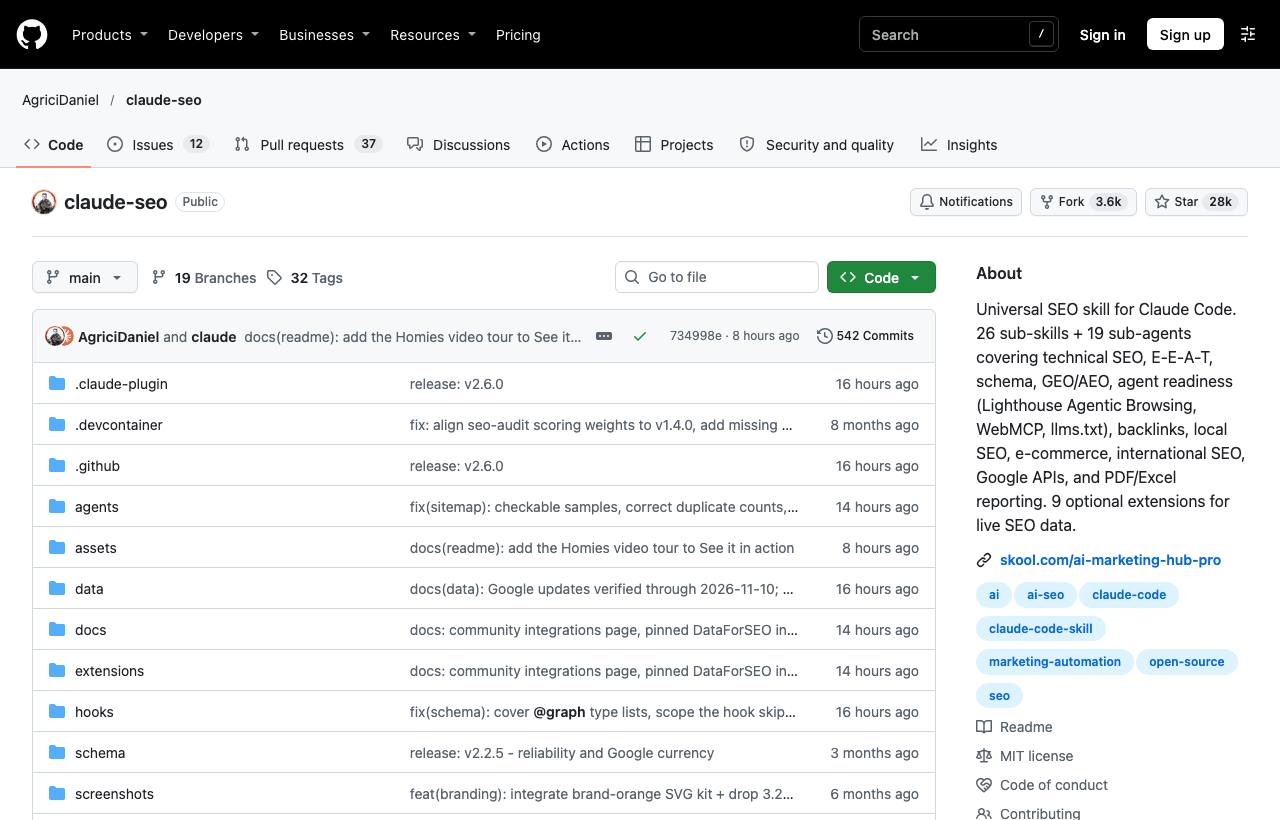
It's a free, open-source Claude Code plugin built by Agrici Daniel. It contains 26 sub-skills and 19 specialist subagents, each owning one area: technical, content, schema, speed, AI search, local, e-commerce and so on. An orchestrator skill called seo takes your command, works out what kind of site it is, and hands the work to agents running in parallel. According to the README, up to 17 agents can audit a site at the same time.
What sets it apart from traditional SEO tools: the output isn't a long list of warnings but a plan with reasons. Each recommendation states what it's based on, what it depends on, and how you'll know the fix worked.
How an audit runs
- Understand the site: the orchestrator detects the business type (SaaS, local, e-commerce, publisher, agency) and adjusts its checks.
- Fan out in parallel: 7 core agents always run (technical, content, schema, sitemap, performance, visual, geo). Others are spawned only when conditions are met, for example
seo-localwhen a local business is detected,seo-googlewhen Google API credentials are available,seo-driftwhen the URL already has a baseline from a previous run. - Aggregate: results are merged, an SEO health score is calculated, and a prioritised action plan is written.
Reports are saved as Markdown on your machine, and /seo google report turns them into a PDF. JavaScript sites (Next.js, React, Vue) are opened in a headless browser, so they're audited the way visitors see them.
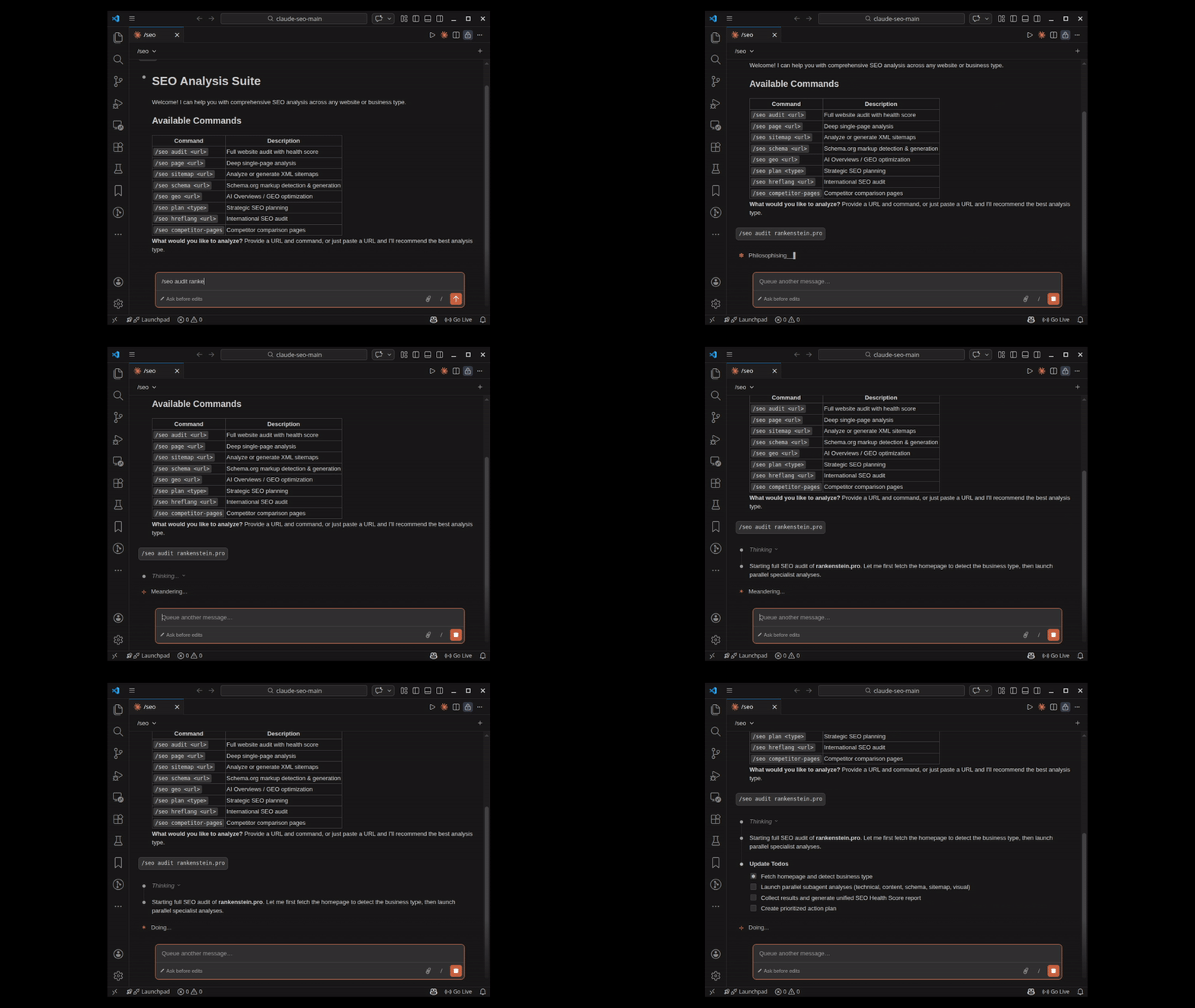
/seo audit fans the work out to parallel agents (source: claude-seo README, MIT)The 19-agent team and command groups
| Group | Key commands | What it does |
|---|---|---|
| Audits & planning | /seo audit, /seo page, /seo plan saas | Full-site audit, deep single-page analysis, SEO strategy by industry |
| Technical SEO | /seo technical, /seo sitemap, /seo hreflang, /seo drift | Crawling, indexing, robots, redirects, Core Web Vitals; catches a site drifting from a known-good state using SQLite snapshots |
| Content & E-E-A-T | /seo content, /seo content-brief, /seo cluster, /seo sxo | Scores content quality, writes briefs, clusters keywords from the SERP, optimises search experience |
| Schema & AI search | /seo schema, /seo geo, /seo agentic | Validates and generates Schema.org; scores how citable pages are for AI; agent readiness (llms.txt, WebMCP, Lighthouse Agentic Browsing) |
| Local, links, commerce | /seo local, /seo maps, /seo backlinks, /seo ecommerce | Google Business Profile, reviews, map pack; backlinks from Moz, Bing, Common Crawl; product pages |
| Extensions (optional) | /seo bing, /seo unlighthouse, /seo seranking, /seo profound | Live data from outside services: Bing Webmaster, IndexNow, Lighthouse for every page, share of voice in AI answers |
On models, the README says the 5 agents that need the most judgment (content, geo, cluster, sxo, drift) run on Opus and the rest on Sonnet. You can change each agent's model in the agents/ folder.
Install and run your first audit
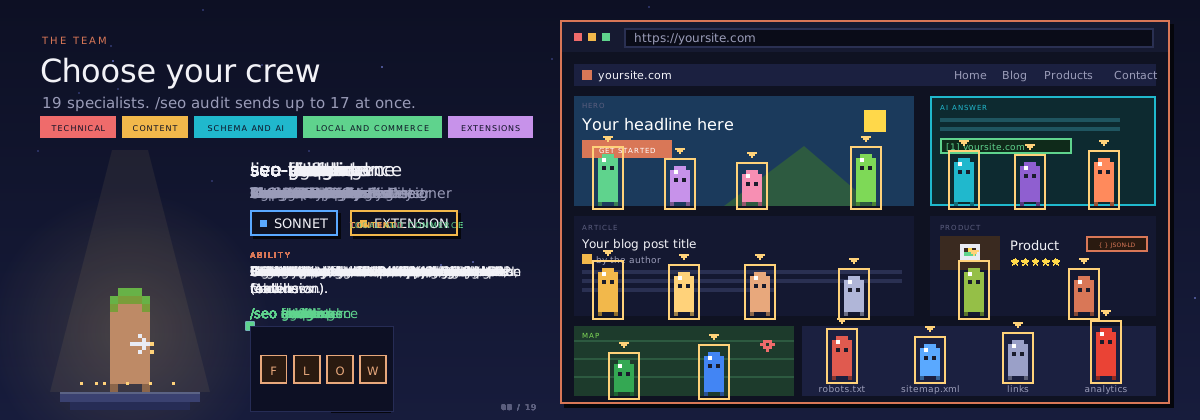
You need Claude Code 1.0.33 or newer and Python 3.11–3.14. Inside Claude Code, type:
/plugin marketplace add AgriciDaniel/claude-seo
/plugin install claude-seo@agricidaniel-claude-seo
/seo setup      # creates its own Python environment + headless Chromium
/seo doctor     # checks readiness without changing your system
Then try it:
/seo audit https://example.com          # full-site audit
/seo page https://example.com/pricing   # one page, in depth
/seo geo https://example.com            # readiness for AI search
/seo schema https://example.com         # check/generate structured data
No API key needed. If you want field data instead of estimates, run /seo google setup to connect Google's free APIs: PageSpeed Insights, Chrome UX Report, Search Console and GA4. The repo also ships install.sh/install.ps1 for manual installs; the author recommends git clone and reading the script before running it, rather than curl | bash.
Results the author reports
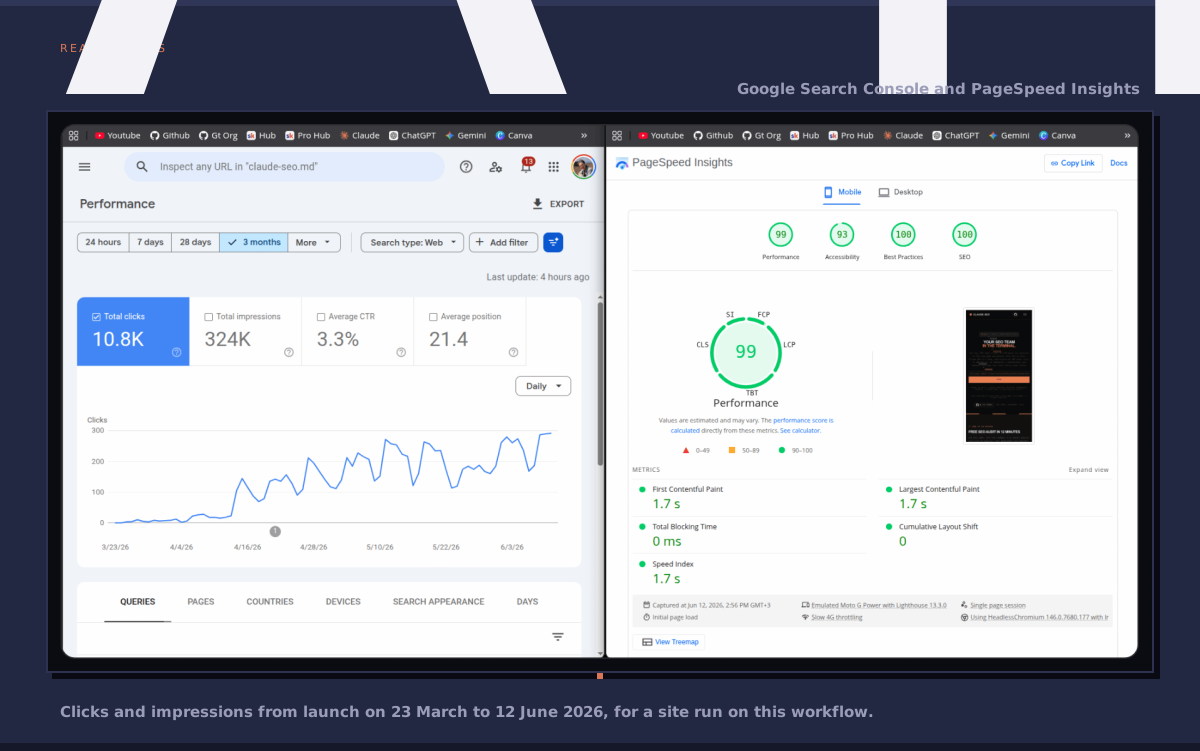
The README points to the project's own site (claude-seo.md), audited with the tool from day one: about 10.8k Search Console clicks in the first 12 weeks and a 99 mobile PageSpeed score. These are self-reported figures for a site with a huge head start (a repo with tens of thousands of stars sends it traffic), so treat them as an illustration, not proof it will work for your site.
Compared with Screaming Frog and SEO suites
The author openly admits that crawlers like Screaming Frog crawl faster and deeper, and big SEO suites have their own backlink databases. Claude SEO's strengths lie elsewhere: it explains its findings, ranks them by impact, goes deep on AI search, and lets you ask follow-up questions in plain English. A sensible setup combines them: a crawler for volume, Claude SEO for interpretation and planning.
Risks and caveats
- Data goes through Anthropic: the content of audited pages is sent to Claude, like everything else in Claude Code. Reports stay on your machine; third parties see data only if you enable an extension or API. Some checks read public sources (Wikipedia, Reddit, Common Crawl). See PRIVACY.md.
- Quota cost: a full
/seo auditruns many agents, some on Opus, so it uses far more of your Claude plan than a single-page check. Try/seo pagefirst. - Limits without Google APIs: Core Web Vitals are lab estimates only, and indexing status is inferred. Pages that load content only after scrolling or clicking can give noisy results.
- The cost comparison in the README is illustrative: figures like "an agency costs over $100k a year" are the author's example, not a survey.
- There's a separate Pro version: the public MIT version is free; paying members of a Skool community get a private version with earlier features. The repo also serves as a funnel for that community.
- AI can still be wrong: schema, canonical and redirect recommendations need review by someone who knows SEO before they hit production.
How to apply this
- Dev: run
/seo technicaland/seo schemabefore every major release. Take a/seo drift baselineonce the site is stable, then/seo drift compareafter each deploy to catch mistakes like an accidentalnoindexor a broken canonical. - Tech Lead: put the Markdown reports in the repo or tickets, and use the "how you'll know it worked" part as acceptance criteria. Consider moving less critical agents to Sonnet to control cost.
- PM / Marketing: use
/seo planand/seo content-briefto build a content roadmap, and/seo geoto see whether the site is ready for AI search. Freelancers can audit during the first meeting to show a score and the top fixes.
Sources & references
- claude-seo — GitHub repository (README) — Agrici Daniel
- Claude SEO — Architecture — Agrici Daniel
- Claude SEO — Privacy — Agrici Daniel
- Claude SEO video tour — Agrici Daniel (YouTube)